
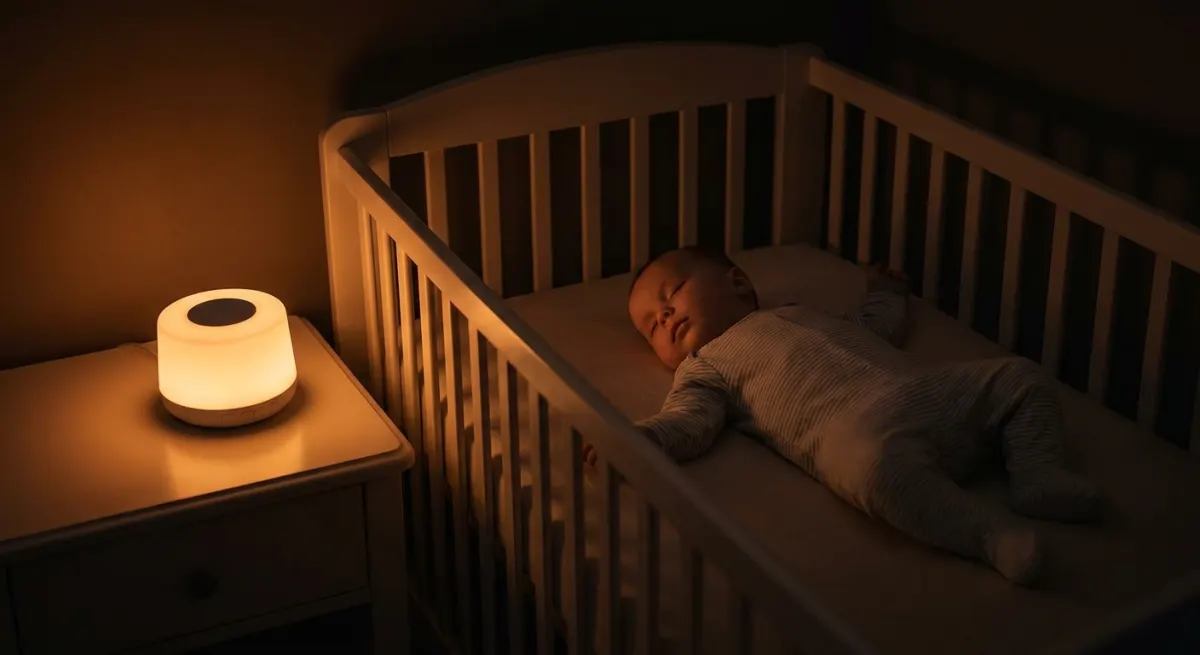
The womb is a surprisingly loud place - a constant, whooshing hum. That is why steady background sound settles so many babies: it masks the sudden noises that jolt them awake and gives them something familiar to sink into. But which sound, and how loud? Here is a short, practical guide.
Which sound to choose
- White noise: a steady, even hush. The reliable all-rounder for deep sleep, and the best place to start.
- Fan: a low, mechanical whir. Similar to white noise, and familiar if you already run one.
- Rain: soft, textured and a little gentler - good for babies who find flat white noise too harsh.
- Ocean: slow rise-and-fall waves. Calming, though the rhythm suits some babies more than others.
- Lullabies: melodic rather than masking. Lovely for winding down, less effective at blocking household noise.
There is no single best sound - it is the one your baby settles to. Try one for a few nights before switching, rather than changing every evening.
How loud, and how to use it safely
- Keep it gentle. Aim for roughly the level of a soft shower, not a vacuum. If you have to raise your voice over it, it is too loud.
- Keep it back. Place the source across the room, not next to the cot.
- Do not run it at full volume all night. Continuous, loud sound is the thing to avoid; a moderate level is fine for naps and bedtime.
- Be consistent. The same sound at every sleep becomes a cue that it is time to settle.
The best white noise is steady, gentle, and the same every night - a signal, not a spectacle.
Sounds for two babies
Sharing a room, twins can usually run one sound between them - and it doubles as a mask for the twin who is still awake when the other goes down. In separate rooms, each baby can have their own.
Where the app fits
Multibaby includes a library of soothing sounds - white noise, lullabies and nature sounds like rain, fan and ocean - that you can start for either baby right from the app, alongside the tracking. One place for the whole bedtime routine, for each child.